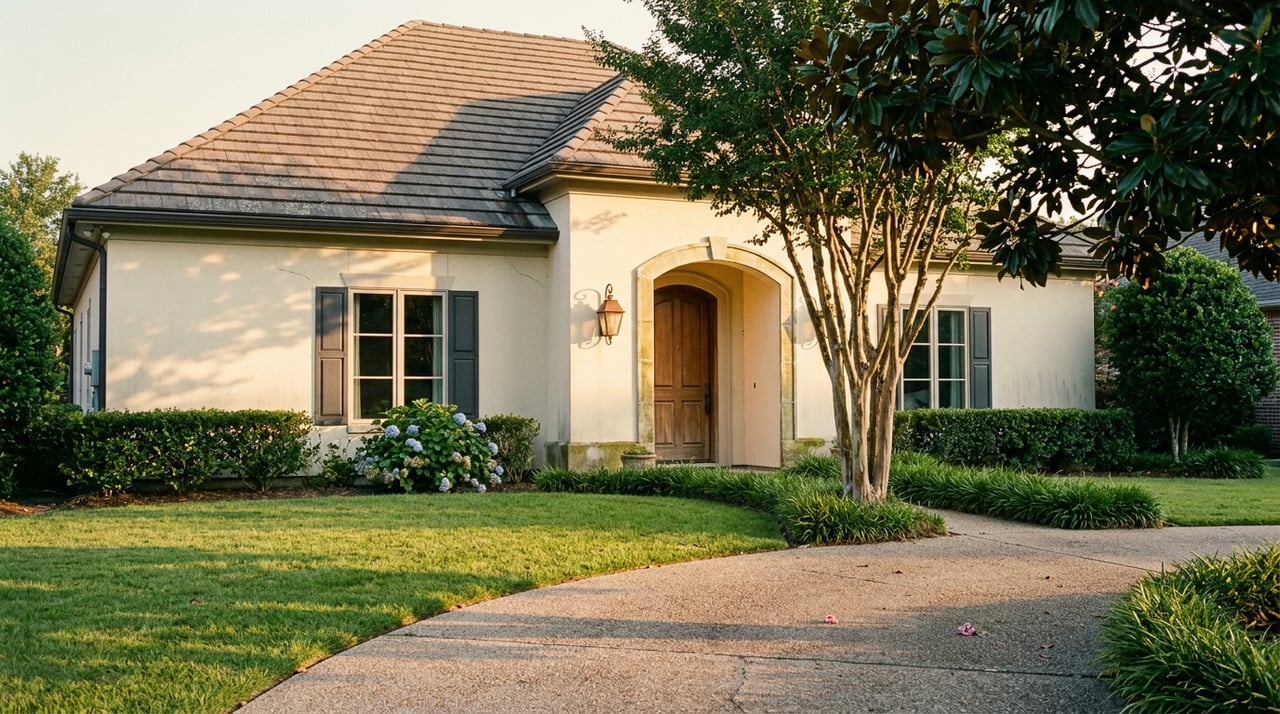
Picture two closings happening the same week in November. One buyer is closing on a home off Metairie Road in Old Metairie. The other is closing on a home near Nashville Avenue in Uptown. Same lender, similar price point, same title company handling both files. When the closing packets land on the two desks, the property tax lines don't match, and it has nothing to do with what the homes are worth. It's because the two houses sit in different parishes, and Jefferson Parish and Orleans Parish don't build, mail, or time a property tax bill the same way.
That mismatch is the part comparison shopping usually skips. A lot of buyers weighing Old Metairie against Uptown or the Garden District start from the assumption that Jefferson Parish is simply the cheaper, less bureaucratic option. The portal numbers seem to back that up. But the two things buyers actually lean on to make that comparison, the tax bill and the median price, are both less apples-to-apples than they look.
The Same Closing Date, Two Different Tax Lines
Louisiana parishes don't run on one shared tax calendar. In Jefferson Parish, tax bills for the current year are mailed in late fall and become due by December 31. In Orleans Parish, the bill for the current year typically goes out on or before January 1 and isn't due until January 31, a full month behind Jefferson's deadline.
That thirty-day gap sounds like a technicality until it shows up on a settlement statement. Buyers and sellers prorate property taxes at closing based on who owned the home for which part of the tax year, and that math depends on whether a bill has actually been issued yet. Close in Old Metairie in early December and the current year's Jefferson bill is likely already sitting in a mailbox somewhere, making the proration a known number. Close in Uptown at the same moment and the Orleans bill for that same tax year may not exist yet, so the title company is estimating against the prior year's rate until the real bill shows up in January. Neither approach is wrong, but they produce different negotiating conversations at the table, and a buyer moving from one parish to the other for the first time is usually caught off guard by which one they're in.
What's Actually Inside the Millage
Once the calendar question is settled, the rate itself needs unpacking, because "Jefferson is cheaper" isn't really a rate comparison, it's a bundling comparison.
Jefferson Parish's parish-wide default millage is 118.40 mills, but that single number hides real variation. The last detailed ward-by-ward breakdown published by the Bureau of Governmental Research showed total rates across Jefferson's individual tax wards ranging from 100.18 to 150.75 mills for the 2024 tax year, depending on which fire district, drainage district, and school levy apply to that specific address. Orleans Parish's East Bank rate for the 2025 tax year sat at 131.99 mills, with Algiers running marginally higher due to a slightly higher levee district tax. BGR's most recent update, published in January 2026, reports that rates ticked up again in both Orleans and Jefferson for the current billing cycle, which means the gap between the two systems is a moving target every year, not a fixed discount for choosing one parish over the other.
The bigger issue is what each millage actually pays for. Orleans Parish residents don't pay a separate property tax for water, sewer, or garbage collection. Most Jefferson Parish residents do. So a lower headline millage in Jefferson doesn't automatically mean a lower total cost of ownership once those municipal services are accounted for, because in New Orleans some of that cost is folded into a different fee structure entirely rather than skipped. The two parishes also fund public education differently. Jefferson Parish schools draw more heavily on sales tax revenue and less on property tax than New Orleans schools do, which is one more reason a straight millage comparison misreads the real tax burden.
The homestead exemption adds a final wrinkle. Louisiana's exemption generally doesn't apply to taxes levied by a municipality, only to parish-level and other qualifying levies. New Orleans is the exception, since it operates as a consolidated city-parish government, so the exemption does apply there. Old Metairie itself is unincorporated, meaning there's no separate city millage layered on top of the parish rate the way there is in incorporated Jefferson Parish municipalities like Harahan, where flat fees for city garbage and fire service can also show up as their own line items on the bill. A buyer comparing Old Metairie to an incorporated Jefferson Parish community like Harahan, not just to Uptown, needs to check for those add-ons before assuming the millage math tells the whole story.
| Old Metairie (Jefferson Parish) | Uptown (Orleans Parish) | |
|---|---|---|
| Current-year tax bill mailed | Late fall | On or before January 1 |
| Current-year tax bill due | December 31 | January 31 |
| Total millage (last published detail) | 118.40 default, 100.18 to 150.75 by ward (2024 tax year) | 131.99 East Bank (2025 tax year) |
| Homestead exemption applies to municipal levy | No separate municipal levy (unincorporated) | Yes, consolidated city-parish exception |
| Water, sewer, garbage funded through property tax | Typically yes | No |
The Median Price Nobody Should Trust
The tax structure is only half the reason a straight comparison misleads people. The other half is that "the median price in Old Metairie" isn't one number. Depending on which slice of the market you're looking at, it's at least three or four different numbers, measured in the same neighborhood at roughly the same time.
One national listings portal's February 2026 snapshot put the median list price for Old Metairie single-family homes at $730,000, with a range running from $225,000 up to $3.1 million and an average of 75 days on market. A separate national portal's closed-sales tool showed something quite different for March 2026: a median sale price of $411,000, down 7.0 percent year over year, at roughly $250 per square foot. That same portal's luxury-inventory filter, looking only at the 35 homes currently marketed as high-end in Old Metairie, showed a median list price of $495,000, lower than the all-homes list-price median from the other source.
None of those figures are wrong. They're measuring different populations. One counts everything currently asking a price, skewed upward by new construction. Another counts only what actually closed, which includes condos, townhomes, and older cottages that never show up in the asking-price mix. A $225,000 to $3.1 million range on the same map means two buyers who both say they're "comparing the median for Old Metairie" might be pricing out an entirely different kind of house, one a renovated cottage near a starter street, the other new construction on a block like Farnham Place. Old Metairie listings also cluster around a handful of recognizable subdivision names, Bonnabel Place, DeLimon Place, and the Metairie Ridge area among them, and the spread between those pockets is wide enough that the neighborhood median tells you almost nothing about what a specific street will cost.
What This Means If You're Weighing Old Metairie Against Uptown
If you're a family comparing Old Metairie to Uptown, the useful question isn't "what's the median in each neighborhood." It's which specific streets you're actually cross-shopping, what the full tax bill looks like once municipal fees and service charges are added back in, and what the closing calendar means for your specific move date. A buyer relocating from out of town on a tight schedule, or a family selling in one parish to buy in the other, benefits from having someone walk the actual settlement math before an offer goes in, not after.
Old Metairie's daily texture is part of what makes the comparison worth having in the first place. Metairie Road, one of the oldest roads in the New Orleans area, still anchors the neighborhood the way it always has, with longstanding stops like Langensteins Grocery and newer additions like Rock n Sake and Fleurty Girl sitting a few blocks from Shipley Do-nuts and the ballfields at Wally Pontiff Jr. Playground. It's a real neighborhood with its own rhythm, not a discount version of anywhere else, and treating it that way in a spreadsheet comparison misses what actually separates one street from another.
A Few Quick Answers
Does Old Metairie have its own city government? No. Old Metairie is an unincorporated community within Jefferson Parish, which means there's no separate municipal millage layered on top of the parish rate, unlike some other Jefferson Parish communities.
Is the homestead exemption identical in Jefferson and Orleans Parish? The parish-level exemption works the same way in both, reducing taxable assessed value by $7,500. Where it diverges is at the municipal level, since New Orleans is the one consolidated city-parish government where the exemption also applies to city-level taxes.
Should I use the median price as my starting budget number? Treat it as a rough range, not a target. The spread between list-price and closed-sale medians in Old Metairie is wide enough that the useful comparison is street-by-street, not neighborhood-wide.
If you're trying to compare what a move from Uptown to Old Metairie, or the reverse, actually costs once the tax bill and the closing calendar are accounted for, that's exactly the kind of math worth walking through before you write an offer. Kara Lashley has spent her career in these neighborhoods and can help you read the real numbers behind the portal median. Let's Connect.