Search "Garden District New Orleans median home price" and open the first three results. You will get three different numbers before lunch, and none of them is wrong. That is the strange part. A seller who anchors to the wrong one can price a listing tens of thousands of dollars off the mark before the first showing. A buyer who takes the highest number at face value can cross streets off a list they could actually afford.
Here is what actually turned up when we pulled the numbers this month.
| Source | Window | Median reported |
|---|---|---|
| Redfin | January 2026 snapshot, 13 sales that month | $620,000 |
| Homes.com neighborhood guide | trailing 12 months | $675,000 |
| Homes.com listings page | trailing 12 months, same site, same week | $1,180,000 |
| Homes.com condo page | as of April 2026 | $1,083,000 median, $1,313,673 average |
| Movoto | August 2026 | $674,000 listed, $358 per square foot |
Four sources, and one of them disagrees with itself twice. All of them are describing the same handful of blocks in the same stretch of 2026. None are fabricating figures. They are each measuring a different slice of a market too small and too split down the middle to produce one honest median.
A Neighborhood That Can't Agree on Its Own Edges
Part of the confusion starts before a single sale gets counted. The Garden District Association sets its own boundary as both sides of Louisiana Avenue, Magazine Street, Josephine Street, and Carondelet Street, a footprint of only a handful of blocks. The Garden District Association is explicit about this. The New Orleans City Planning Commission draws a larger box: St. Charles Avenue to the north, First Street to the east, Magazine Street to the south, Toledano Street to the west. The National Historic Landmark designation, as documented on Wikipedia, stretches further still, one block west past Toledano to Louisiana Avenue, one block north past St. Charles to Carondelet Street, and three blocks east past First Street to Josephine Street.
Three legitimate, official boundaries for the same neighborhood name. When a data provider builds its map, it has to pick one, and different providers pick differently. A sale on a block near the Toledano edge might count as Garden District on one site's map and get filed under Uptown or Irish Channel on another's. Repeat that classification call across a few dozen transactions a year and you can shift a median by tens of thousands of dollars without a single home changing in value.
The Real Problem Isn't the Boundary. It's the Sample Size.
Even if every site drew identical lines tomorrow, the pool of transactions inside them is tiny. Redfin's own page shows only 13 Garden District home sales in January 2026, down from 29 the January before. Thirteen closings. In a neighborhood where the least expensive listings run in the low $200,000s and the grandest restored mansions sell for $1 million to $3 million, by Homes.com's own description of the local stock, thirteen sales is nowhere near enough to hold a stable middle. Let two mansions close in the same month and the median jumps. Let a run of smaller condo conversions close instead, and it falls just as fast. That isn't the market appreciating 77 percent or correcting 16 percent. That's sampling noise wearing a market trend's clothes.
You can watch the split happen in real listings. The Henderson McCloskey Mansion, built in 1882 by John Henderson as a wedding gift, restored with five fireplaces and 13-foot ceilings, sits inside the same "Garden District" bucket as condos currently listed as low as $225,000 a few blocks away. So does the historic building at the corner of Jackson Avenue and Prytania Street, designed by architect Henry Howard in 1852 and once home to Pope's Pharmacy, now marketed as a standalone architectural rarity. Feed a dataset that range and it will never settle into a smooth bell curve. It will lurch, block by block, sale by sale.
What the Median Can't See: Parking
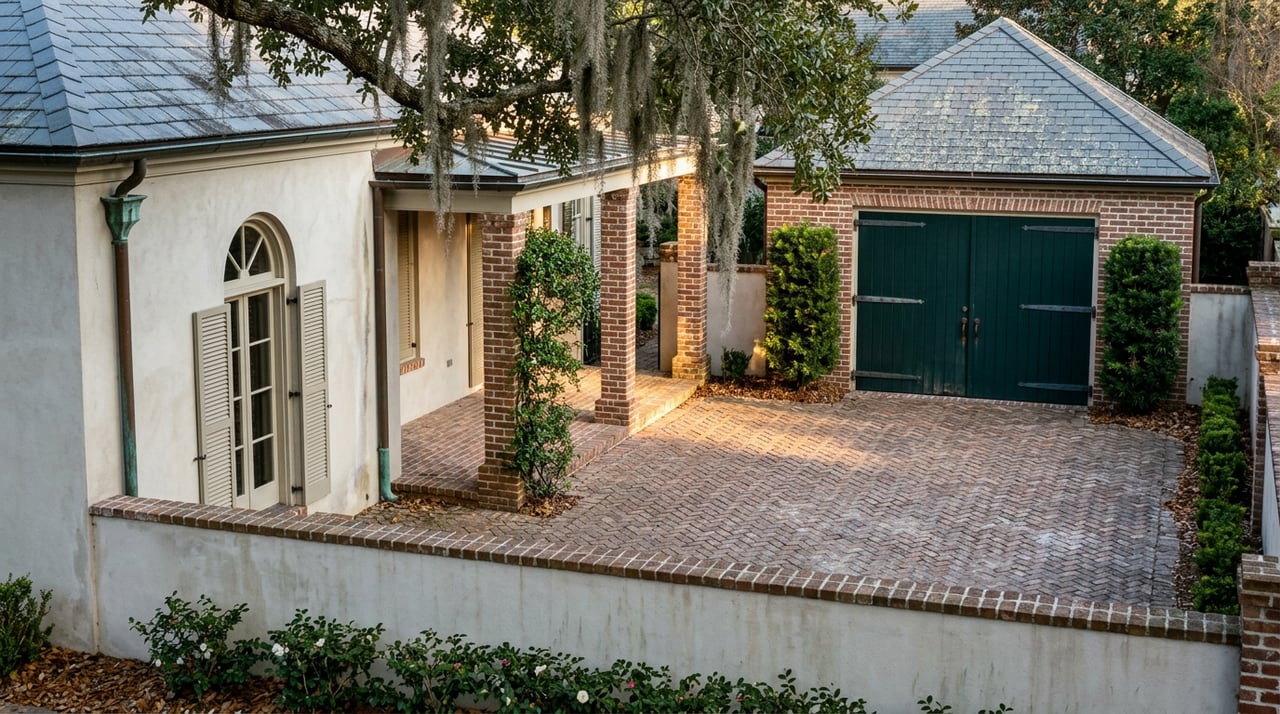
While the headline number swings, one feature keeps showing up across nearly every high-end Garden District listing we reviewed this year: gated, off-street parking. It isn't a footnote buried in the details. Listings lead with it. One recent Garden District listing runs "2 PARKING SPACES! BALCONY!" as its actual headline. Another advertises an automatic gate with room for seven cars behind it. The Henderson McCloskey Mansion's own listing calls out gated off-street parking as a named exterior feature, right alongside the five fireplaces and the renovated spa bath.
That emphasis exists because parking here is genuinely scarce. These blocks were laid out between the 1830s and the 1890s for households that didn't own two cars, and most original lots were never built with a driveway in mind. Two homes with identical square footage and bedroom counts can carry meaningfully different value once you factor in whether one has a place to park behind a gate and the other relies on street parking during Carnival season or a Saints game weekend. No median price, sourced from any site, captures that difference. You only see it by walking the actual comparable properties, block by block, which is work no aggregator does for you.
What This Means If You're Actually Buying or Selling Here
If you're pricing a Garden District listing, don't lead with a citywide or even a neighborhood-wide median pulled from a portal. Ask what the last handful of genuinely comparable sales looked like, matched by property type, block, and parking situation, because that narrower sample is the only one that means anything in a market this small. A restored single-family home two blocks off St. Charles Avenue and a condo conversion near The Rink, the old roller rink turned shopping center that now houses the Garden District Book Shop and the Chicory House, are not competing in the same price tier even though every major site files them under the identical neighborhood name.
If you're house hunting and a headline figure scared you off, know that the same "Garden District" heading covers everything from a one-bedroom condo to a five-fireplace 1880s mansion two blocks apart, and your actual budget likely fits somewhere real inside that range.
Days on market tells a steadier story than price this year. Movoto's August 2026 data put the typical Garden District listing at 74 days before going under contract, unchanged from August 2025. That kind of stability, even while headline medians bounce between $620,000 and $1,180,000 depending on which page you land on, is a better signal that this remains a steady, walkable, high-demand pocket of the city rather than one swinging wildly in value.
The number you saw this morning was real. It just wasn't the whole neighborhood, and it was never going to be the number on your closing statement. If you're weighing a Garden District purchase or sale and want someone who tracks these blocks individually rather than by aggregate, Kara Lashley can walk the actual comparables with you. Let's Connect.